Many aerospace organizations struggle with common AS9100 internal audit findings because audit preparation is treated as a temporary event instead of part of a continuously operating quality management system.
Procedures are updated days before the audit, records are rushed into completion, and corrective actions suddenly become urgent only when an external auditor is approaching. While this approach may temporarily reduce visible gaps, it often weakens long-term process effectiveness and operational stability.
An effective AS9100 quality management system should function continuously, not only during AS9100 audit preparation periods.
Audits Should Reflect Daily Operations
Internal audits are intended to evaluate:
- process effectiveness
- compliance to planned arrangements
- operational implementation
- system interaction
- risk management
- continual improvement
When organizations shift into “audit mode,” the audit no longer reflects the true condition of the management system.
Instead, employees often experience:
- rushed document updates
- incomplete training records suddenly being corrected
- uncontrolled forms being replaced temporarily
- overdue actions closed rapidly without proper verification
- reactive management involvement
These conditions are frequently associated with common AS9100 internal audit findings because the underlying operational weaknesses remain unresolved.
Common Signs of Reactive AS9100 Audit Preparation
Last-Minute Document Cleanup
Procedures, forms, and records are updated immediately before external audits rather than maintained continuously.
Corrective Actions Closed Without Effectiveness Verification
Organizations rush NCR closures to reduce open findings while failing to verify long-term corrective action effectiveness.
Internal Audits Delayed Until Certification Approaches
Internal audit schedules drift behind until external audits become imminent.
Management Review Conducted Only for Compliance
Meetings occur to satisfy audit expectations rather than support operational decision-making.
Employee Awareness Changes During Audit Weeks
Personnel suddenly become heavily focused on procedures and documentation only during audit preparation periods.
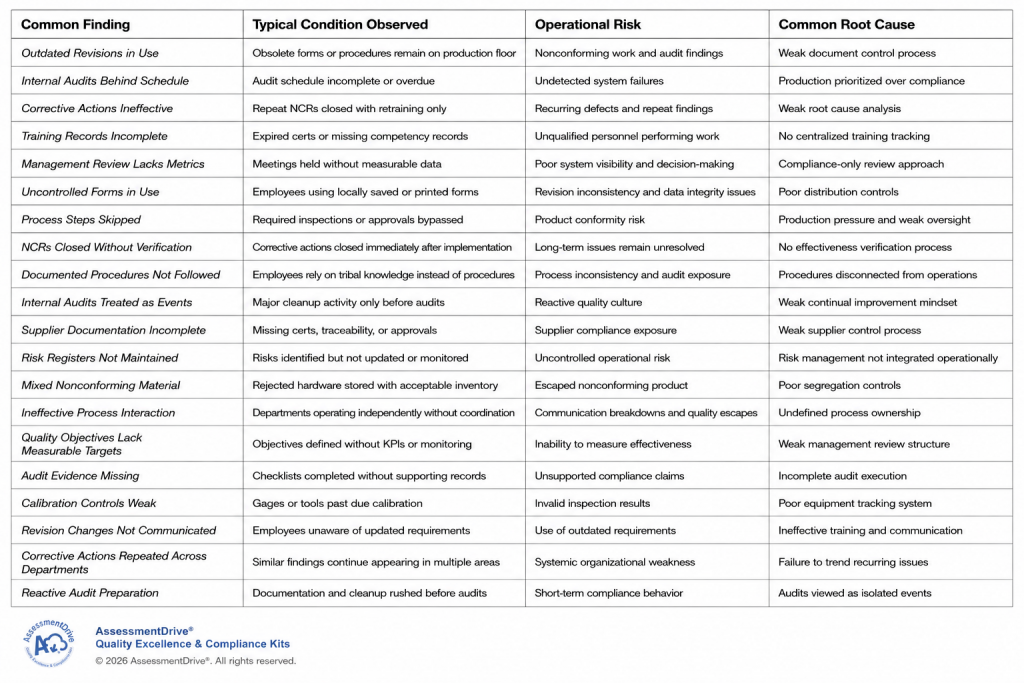
| Common Finding | Typical Condition Observed | Operational Risk | Common Root Cause |
|---|---|---|---|
| Outdated Revisions in Use | Obsolete forms or procedures remain on production floor | Nonconforming work and audit findings | Weak document control process |
| Internal Audits Behind Schedule | Audit schedule incomplete or overdue | Undetected system failures | Production prioritized over compliance |
| Corrective Actions Ineffective | Repeat NCRs closed with retraining only | Recurring defects and repeat findings | Weak root cause analysis |
| Training Records Incomplete | Expired certs or missing competency records | Unqualified personnel performing work | No centralized training tracking |
| Management Review Lacks Metrics | Meetings held without measurable data | Poor system visibility and decision-making | Compliance-only review approach |
| Uncontrolled Forms in Use | Employees using locally saved or printed forms | Revision inconsistency and data integrity issues | Poor distribution controls |
| Process Steps Skipped | Required inspections or approvals bypassed | Product conformity risk | Production pressure and weak oversight |
| NCRs Closed Without Verification | Corrective actions closed immediately after implementation | Long-term issues remain unresolved | No effectiveness verification process |
| Documented Procedures Not Followed | Employees rely on tribal knowledge instead of procedures | Process inconsistency and audit exposure | Procedures disconnected from operations |
| Internal Audits Treated as Events | Major cleanup activity only before audits | Reactive quality culture | Weak continual improvement mindset |
| Supplier Documentation Incomplete | Missing certs, traceability, or approvals | Supplier compliance exposure | Weak supplier control process |
| Risk Registers Not Maintained | Risks identified but not updated or monitored | Uncontrolled operational risk | Risk management not integrated operationally |
| Mixed Nonconforming Material | Rejected hardware stored with acceptable inventory | Escaped nonconforming product | Poor segregation controls |
| Ineffective Process Interaction | Departments operating independently without coordination | Communication breakdowns and quality escapes | Undefined process ownership |
| Quality Objectives Lack Measurable Targets | Objectives defined without KPIs or monitoring | Inability to measure effectiveness | Weak management review structure |
| Audit Evidence Missing | Checklists completed without supporting records | Unsupported compliance claims | Incomplete audit execution |
| Calibration Controls Weak | Gages or tools past due calibration | Invalid inspection results | Poor equipment tracking system |
| Revision Changes Not Communicated | Employees unaware of updated requirements | Use of outdated requirements | Ineffective training and communication |
| Corrective Actions Repeated Across Departments | Similar findings continue appearing in multiple areas | Systemic organizational weakness | Failure to trend recurring issues |
| Reactive Audit Preparation | Documentation and cleanup rushed before audits | Short-term compliance behavior | Audits viewed as isolated events |
Risks Associated With Common AS9100 Internal Audit Findings
Reactive audit preparation can create significant operational risks:
- recurring nonconformances
- ineffective corrective actions
- outdated revision usage
- uncontrolled documentation
- customer dissatisfaction
- reduced process visibility
- weakened continual improvement
Over time, organizations may become dependent on audit preparation cycles instead of maintaining a stable and functional management system.
Effective AS9100 Systems Operate Continuously
Strong AS9100 environments typically demonstrate:
- ongoing internal audits
- controlled documentation practices
- measurable management review inputs
- effective corrective action follow-up
- active process ownership
- operational accountability
- continual risk awareness
External audits then become a validation of normal operations rather than a temporary organizational event.
Internal Audits Should Identify Operational Reality
An effective internal audit process should evaluate whether documented processes are functioning operationally throughout normal production activity.
This includes identifying:
- gaps between procedures and execution
- recurring operational breakdowns
- ineffective controls
- process interaction failures
- weak corrective action implementation
- disconnected quality objectives
Internal audits become substantially more valuable when they focus on operational effectiveness rather than checklist completion alone.
Conclusion
Many common AS9100 internal audit findings originate not from missing procedures, but from management systems operating reactively instead of continuously.
Organizations that maintain operational discipline outside of audit periods often develop stronger corrective action systems, improved process consistency, and more effective long-term compliance performance.
A mature quality management system should remain functional regardless of whether an auditor is present.