Understanding the AS9100D Clause Crosswalk
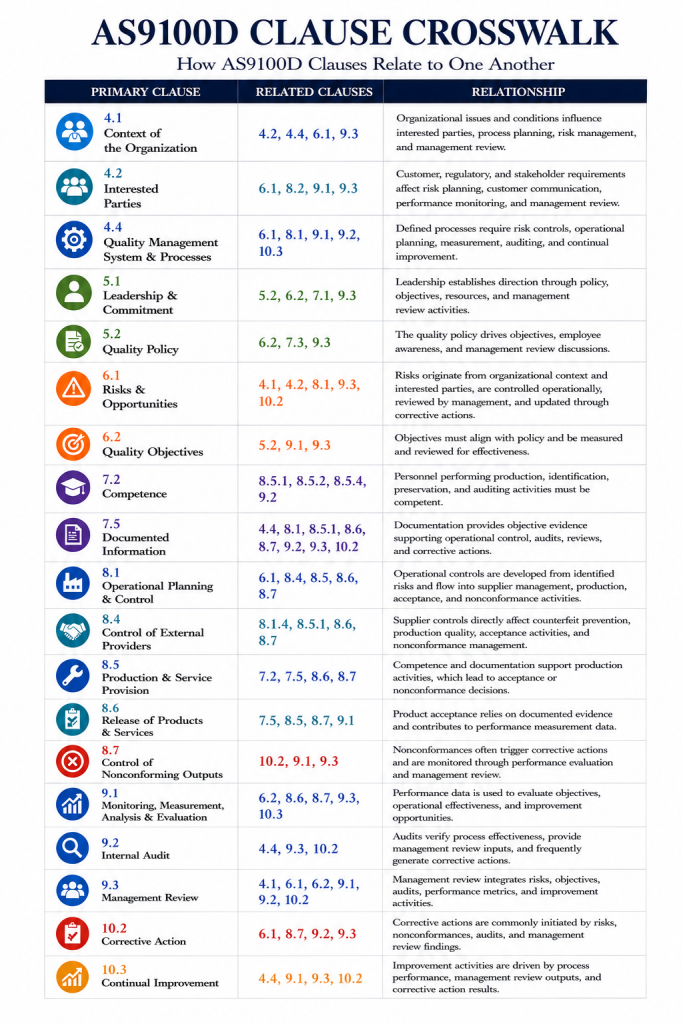
Many organizations implement AS9100D by focusing on individual clauses one at a time. While this approach can help establish compliance, it often overlooks how the requirements interact throughout the quality management system (QMS). This is where a AS9100D clause crosswalk can assist.
AS9100D was designed as an integrated management system where information, risks, objectives, resources, operational controls, audits, and improvement activities continuously influence one another.
A ASD9100D clause crosswalk helps organizations understand these relationships and identify where changes to one process may affect other areas of the QMS.
Why a Clause Crosswalk Matters
Understanding clause relationships can help organizations:
- Improve implementation effectiveness
- Strengthen audit readiness
- Reduce documentation gaps
- Identify process interactions
- Support risk-based thinking
- Improve management review activities
- Strengthen corrective action processes
Rather than viewing clauses as independent requirements, organizations should view them as connected components of a single system.
Clause 4: Context of the Organization
Clause 4 establishes the foundation of the quality management system.
Related Clauses
- 4.2 Interested Parties
- 4.4 Quality Management System Processes
- 6.1 Risks and Opportunities
- 9.3 Management Review
Relationship
Organizational issues, customer expectations, regulatory requirements, and stakeholder needs identified under Clause 4 become direct inputs to risk management and strategic planning activities.
Without understanding organizational context, effective risk management becomes difficult.
| Subclause | Related Clauses | Relationship |
|---|---|---|
| 4.1 Understanding the Organization and Its Context | 6.1, 9.3 | Organizational issues become inputs to risk management and management review. |
| 4.2 Understanding the Needs and Expectations of Interested Parties | 6.1, 8.2, 9.1, 9.3 | Stakeholder requirements influence risks, customer requirements, performance evaluation, and review activities. |
| 4.3 Determining the Scope of the QMS | 4.4, 9.2 | Scope defines the boundaries of audited and controlled processes. |
| 4.4 Quality Management System and Its Processes | 6.1, 8.1, 9.1, 9.2, 10.3 | Processes drive planning, operations, measurement, auditing, and improvement. |
Clause 5: Leadership
Leadership establishes direction for the entire QMS.
Related Clauses
- 5.2 Quality Policy
- 6.2 Quality Objectives
- 7.1 Resources
- 9.3 Management Review
Relationship
Leadership commitment influences quality objectives, resource allocation, employee engagement, and management review effectiveness.
Organizations frequently experience system breakdowns when leadership involvement becomes limited.
| Subclause | Related Clauses | Relationship |
|---|---|---|
| 5.1 Leadership and Commitment | 5.2, 6.2, 7.1, 9.3 | Leadership establishes direction, resources, and oversight. |
| 5.2 Quality Policy | 6.2, 7.3, 9.3 | Policy drives objectives, awareness, and management review. |
| 5.3 Organizational Roles, Responsibilities and Authorities | 7.2, 8.5, 9.2 | Responsibilities support competence, operations, and audits. |
Clause 6: Planning
Planning converts organizational objectives into actionable controls.
Related Clauses
- 4.1 Context
- 4.2 Interested Parties
- 8.1 Operational Planning
- 9.3 Management Review
- 10.2 Corrective Action
Relationship
Risks and opportunities identified through planning activities directly affect operational controls, supplier management, inspection activities, and corrective action processes.
Effective planning creates the foundation for proactive quality management.
| Subclause | Related Clauses | Relationship |
|---|---|---|
| 6.1 Actions to Address Risks and Opportunities | 4.1, 4.2, 8.1, 9.3, 10.2 | Risks originate from context and drive operational controls and improvement actions. |
| 6.2 Quality Objectives and Planning to Achieve Them | 5.2, 9.1, 9.3 | Objectives support policy and require measurement and review. |
| 6.3 Planning of Changes | 8.1, 7.5, 9.3 | Planned changes affect operations, documentation, and leadership review. |
Clause 7: Support
Clause 7 provides the infrastructure required to operate the QMS.
Related Clauses
- 4.4 Process Management
- 8.1 Operational Planning
- 8.5 Production and Service Provision
- 9.2 Internal Audit
- 10.2 Corrective Action
Relationship
Resources, competence, awareness, communication, and documented information support every operational process within the organization.
Without adequate support processes, operational compliance becomes difficult to sustain.
| Subclause | Related Clauses | Relationship |
|---|---|---|
| 7.1 Resources | 5.1, 8.5, 9.1 | Resources support operations and performance. |
| 7.2 Competence | 8.5, 9.2 | Qualified personnel are required for production and auditing. |
| 7.3 Awareness | 5.2, 8.5 | Personnel must understand policies and operational requirements. |
| 7.4 Communication | 8.2, 9.3 | Communication supports customer interaction and leadership review. |
| 7.5 Documented Information | 4.4, 8.1, 8.5, 8.6, 8.7, 9.2, 9.3, 10.2 | Documentation provides objective evidence throughout the QMS. |
Clause 8: Operation
Clause 8 contains the operational controls required to produce conforming products and services.
Related Clauses
- 6.1 Risks and Opportunities
- 8.4 Control of External Providers
- 8.5 Production and Service Provision
- 8.6 Release of Products and Services
- 8.7 Control of Nonconforming Outputs
Relationship
Operational controls are developed from planning activities and generate much of the data later reviewed under performance evaluation and improvement processes.
Supplier performance, production controls, inspections, and nonconformance management all originate within Clause 8.
| Subclause | Related Clauses | Relationship |
|---|---|---|
| 8.1 Operational Planning and Control | 6.1, 8.4, 8.5, 8.6, 8.7 | Risks are translated into operational controls. |
| 8.2 Requirements for Products and Services | 4.2, 7.4, 8.5 | Customer requirements drive production activities. |
| 8.3 Design and Development | 8.5, 8.6, 8.7 | Design outputs affect production, acceptance, and nonconformance activities. |
| 8.4 Control of Externally Provided Processes, Products and Services | 8.1.4, 8.5, 8.6, 8.7 | Supplier controls affect product conformity. |
| 8.5 Production and Service Provision | 7.2, 7.5, 8.6, 8.7 | Production relies on competence and controlled documentation. |
| 8.6 Release of Products and Services | 7.5, 9.1 | Acceptance records support performance measurement. |
| 8.7 Control of Nonconforming Outputs | 9.1, 9.3, 10.2 | Nonconformances drive evaluation and corrective action. |
Clause 9: Performance Evaluation
Clause 9 determines whether the quality management system is performing effectively.
Related Clauses
- 6.2 Quality Objectives
- 8.6 Product Release
- 8.7 Nonconforming Outputs
- 9.2 Internal Audit
- 9.3 Management Review
- 10.3 Continual Improvement
Relationship
Performance metrics, audit findings, customer feedback, and process results provide objective evidence regarding the effectiveness of the QMS.
This information drives management decisions and improvement activities.
| Subclause | Related Clauses | Relationship |
|---|---|---|
| 9.1 Monitoring, Measurement, Analysis and Evaluation | 6.2, 8.6, 8.7, 10.3 | Data is used to assess effectiveness and improvement opportunities. |
| 9.2 Internal Audit | 4.4, 9.3, 10.2 | Audits verify process effectiveness and often generate corrective actions. |
| 9.3 Management Review | 4.1, 6.1, 6.2, 9.1, 9.2, 10.2 | Leadership reviews overall QMS effectiveness and performance. |
Clause 10: Improvement
Clause 10 focuses on correcting issues and improving system performance.
Related Clauses
- 6.1 Risks and Opportunities
- 8.7 Nonconforming Outputs
- 9.2 Internal Audit
- 9.3 Management Review
Relationship
Corrective actions often originate from audits, customer complaints, nonconformances, and management review outputs.
Improvement activities should ultimately influence future risk assessments and planning decisions.
| Subclause | Related Clauses | Relationship |
|---|---|---|
| 10.1 General | 9.1, 9.3 | Improvement activities are based on performance and review outputs. |
| 10.2 Nonconformity and Corrective Action | 6.1, 8.7, 9.2, 9.3 | Corrective actions address findings from risks, audits, and nonconformances. |
| 10.3 Continual Improvement | 4.4, 9.1, 9.3, 10.2 | Improvement activities are driven by process performance and corrective action results. |
Common Clause Relationships Auditors Evaluate
During AS9100 audits, auditors frequently examine connections between clauses rather than reviewing requirements in isolation.
Examples include:
Risk Management to Operations
An auditor may verify whether risks identified under Clause 6.1 are reflected within operational controls under Clause 8.1.
Internal Audits to Corrective Actions
Audit findings generated under Clause 9.2 should flow into corrective action processes under Clause 10.2 when necessary.
Management Review to Improvement
Management review outputs under Clause 9.3 should result in actions, decisions, and improvement opportunities.
Competence to Production Activities
Personnel performing production, inspection, and verification activities should have competency records supporting assigned responsibilities.
Using the Crosswalk During Implementation
Organizations can use a clause crosswalk to:
- Develop procedures
- Perform internal audits
- Conduct gap assessments
- Prepare for certification audits
- Evaluate process interactions
- Improve management review effectiveness
When a process changes, the crosswalk can help identify other clauses that may be affected.
Conclusion
AS9100D is not a collection of independent requirements. It is a connected management system where risks, objectives, resources, operational controls, audits, and improvement activities continuously interact.
Organizations that understand these relationships are often better positioned to maintain compliance, improve performance, and demonstrate system effectiveness during certification and surveillance audits.
A clause crosswalk provides a practical framework for understanding how AS9100D functions as an integrated aerospace quality management system rather than a series of standalone requirements.