When to Record an NCR vs Initiate Corrective Action
Understanding the difference between a single nonconforming part and a systemic issue is critical for maintaining compliance with AS9100D (NCR vs CAR AS9100D). Misclassification leads to repeat defects, weak responses, and audit findings tied to clause 10.2.
What Is a One-Off Nonconformance
Definition and Scope
A one-off nonconformance is an isolated event where a product fails to meet requirements with no evidence of recurrence or process failure.
Key Characteristics
- Limited to a single part or event
- Cause is specific and contained
- No pattern across jobs, shifts, or personnel
- No indication of process breakdown
Examples
- Incorrect hole size on one component
- Cosmetic defect outside tolerance on a single unit
- Missing traveler step on one job
Required Response
- Record in an NCR
- Segregate and disposition (rework, repair, scrap, use-as-is)
- Document immediate correction
- Perform basic risk review for recurrence
Role of NCRs
Nonconformance Reports (NCRs) focus on the product. They exist to identify, control, and correct issues on parts and assemblies. The goal is to fix what is in front of you, prevent escape, and ensure only conforming product moves forward.
What Is a Systemic Issue
Definition and Scope
A systemic issue reflects failure within the quality management system. The problem is repeatable, widespread, or rooted in weak controls.
Key Characteristics
- Recurring issues across jobs or time
- Multiple personnel or departments involved
- Process controls not followed or ineffective
- Gaps in training, procedures, or oversight
- Elevated risk to conformity or customer satisfaction
Examples
- QC inspections skipped before welding
- Outdated authorization lists used for inspection approval
- Calibration controls applied inconsistently
- Repeat NCRs for similar defects with no lasting fix
When Corrective Action Is Required
AS9100D Clause 10.2 Triggers
Clause 10.2 of AS9100D requires corrective action when issues extend beyond isolated events.
Common Triggers
- Repeat occurrences of similar nonconformances
- Evidence of process failure
- Customer complaints or escapes
- Internal audit findings
- Risk indicating broader impact
Required Elements of Corrective Action
- Clear problem definition with objective evidence
- Root cause analysis focused on true cause
- Action plan to eliminate root cause
- Implementation of actions
- Verification of effectiveness
- Controlled records
Role of CARs
Corrective Action Requests (CARs) focus on the system. They are used to eliminate root causes and strengthen processes so the issue does not return. Where an NCR fixes the part, a CAR fixes how the work is performed.
Correction vs Corrective Action
How They Show Up in Practice
One-off nonconformance
You find a defect, stop the job, tag the part, document the issue, and disposition it. Once corrected, the issue is considered contained with low expectation of repeat.
Systemic issue
You begin to see the same issue across jobs or operators. NCRs continue to appear for similar conditions. At this point, the process is not holding control. A CAR becomes necessary to address the root cause and prevent recurrence.
Side-by-Side Breakdown
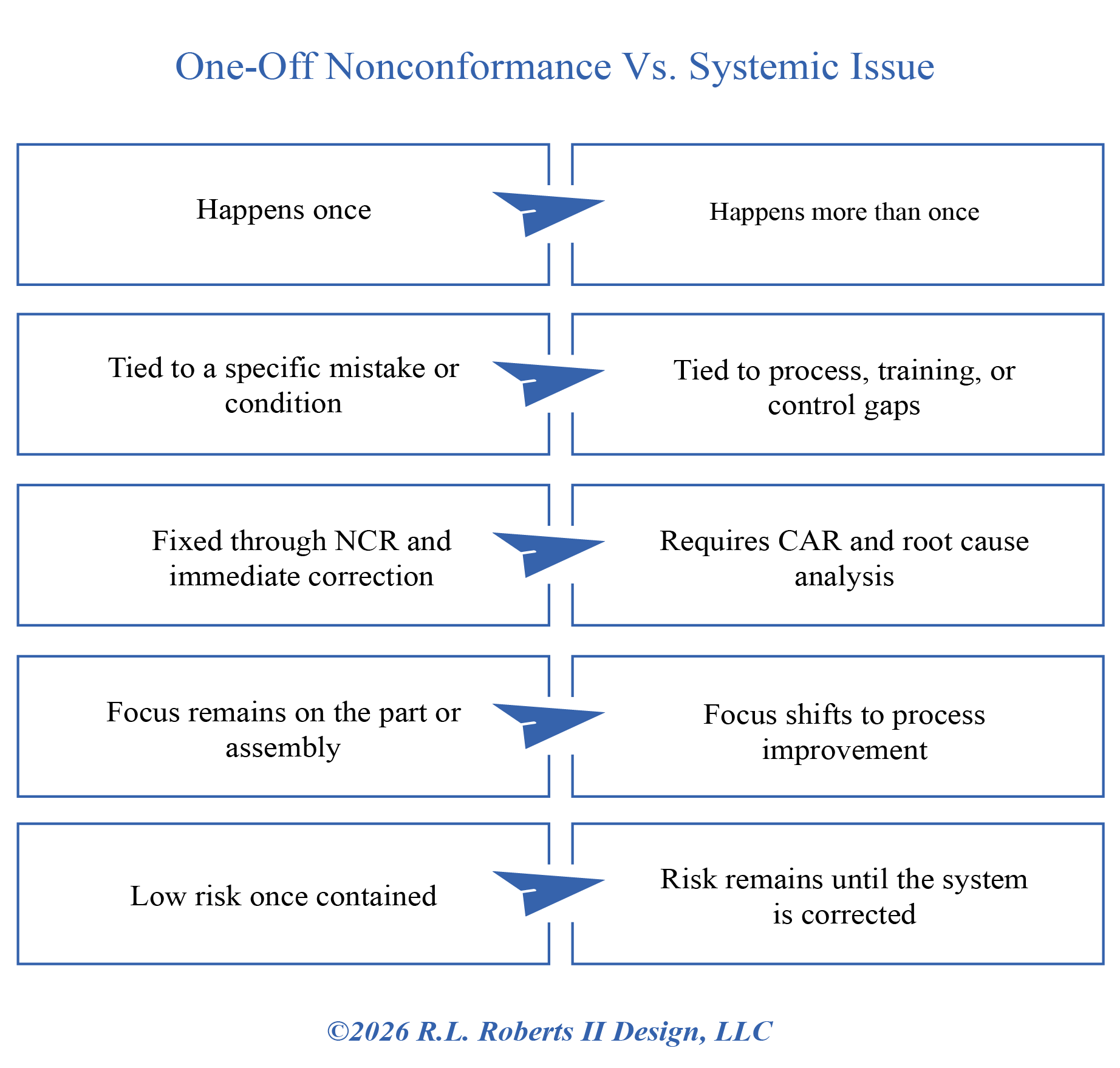
Plain Language Comparison
One-off nonconformance
- Happens once
- Tied to a specific mistake or condition
- Fixed through NCR and immediate correction
- Focus remains on the part or assembly
- Low risk once contained
Systemic issue
- Happens more than once
- Tied to process, training, or control gaps
- Requires CAR and root cause analysis
- Focus shifts to process improvement
- Risk remains until the system is corrected
Practical Example: QC Being Skipped
Isolated vs Systemic
If one part bypasses QC due to oversight, treat as an NCR.
The part is controlled, corrected, and dispositioned.
If parts routinely move to welding without QC:
- Indicates breakdown in process control
- Reflects failure in enforcement and accountability
- NCRs may capture each occurrence, but they do not solve the underlying issue
- A CAR is required to correct the process and prevent repeat
Risk of Misclassification
Consequences
Treating systemic issues as isolated NCRs leads to:
- Recurring defects
- Repeated rework and cost
- Audit findings for ineffective action
- Reduced confidence in the QMS
Auditors expect organizations to move beyond part-level fixes and address process-level failures.
Recommended Approach
Practical Steps
- Record all nonconformances using NCRs
- Trend NCR data to identify patterns
- Escalate repeated issues into CARs
- Focus CARs on root cause, not symptoms
- Verify effectiveness before closure
Conclusion
Key Takeaway
An NCR fixes the part or assembly. A CAR strengthens the process. The distinction depends on recurrence, scope, and risk. Proper use of both ensures compliance with AS9100D and drives real improvement across the system.