Why Supplier Quality Drives AS9100D Outcomes
Supplier performance directly affects product conformity, delivery, and customer satisfaction. Clause 8.4 failures frequently lead to major nonconformities because external providers influence risk outside direct operational control.
Common audit triggers include:
• Unclear supplier approval logic
• Weak requirement flow-down
• Inconsistent monitoring methods
• Reactive corrective action handling
Strong supplier quality systems rely on defined controls, proportional risk treatment, and objective evidence.
AS9100D Clause 8.4 Overview
Clause 8.4 focuses on control of externally provided processes, products, and services.
Core expectations include
• Defined supplier approval criteria
• Risk-based application of controls
• Clear purchasing requirements
• Ongoing performance monitoring
• Re-evaluation and corrective action
Auditors look for consistency between documented processes and execution.
Supplier Classification and Risk Segmentation
Why Risk Segmentation Matters
Supplier controls must scale with risk. Uniform controls across all suppliers often signal weak risk-based thinking.
Effective segmentation considers
• Product criticality
• Special process involvement
• Regulatory impact
• Past performance trends
Common Supplier Categories
• Commercial off-the-shelf suppliers
• Raw material suppliers
• Special process providers
• Calibration and test labs
• Subcontract manufacturers
Each category supports different control depths.
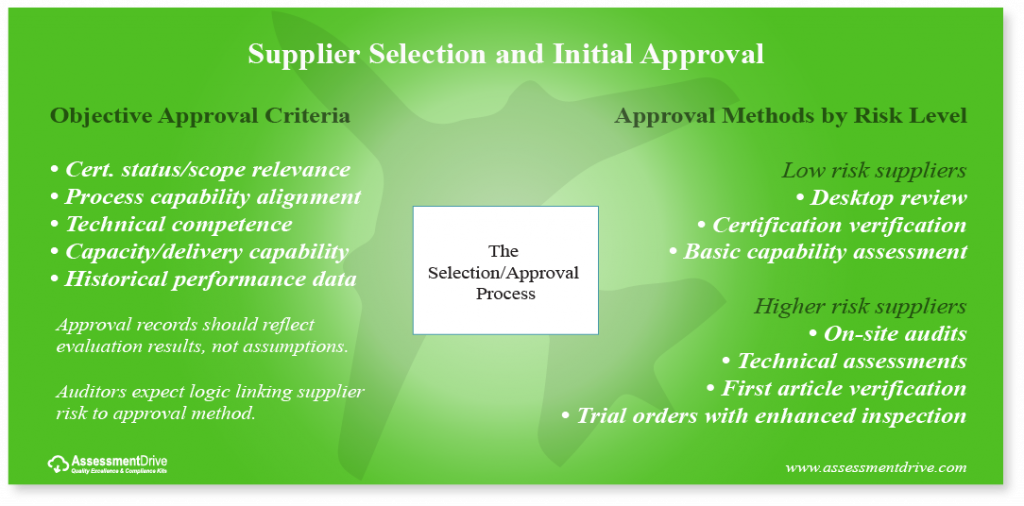
Supplier Selection and Initial Approval
Objective Approval Criteria
Supplier approval relies on documented, repeatable criteria.
Common inputs include
• Certification status and scope relevance
• Process capability alignment
• Technical competence
• Capacity and delivery capability
• Historical performance data
Approval records should reflect evaluation results, not assumptions.
Approval Methods by Risk Level
Low risk suppliers
• Desktop review
• Certification verification
• Basic capability assessment
Higher risk suppliers
• On-site audits
• Technical assessments
• First article verification
• Trial orders with enhanced inspection
Auditors expect logic linking supplier risk to approval method.
Purchasing Information and Requirement Flow-Down
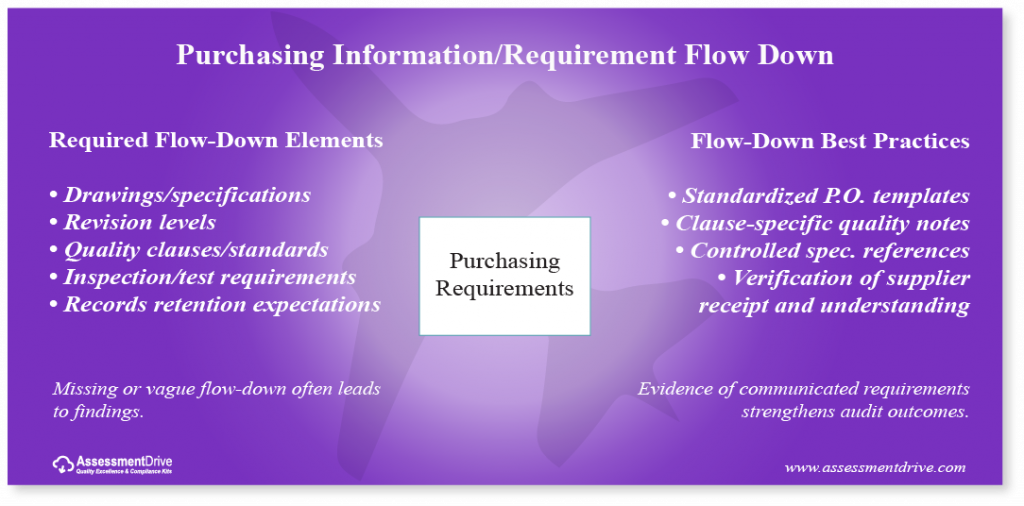
Required Flow-Down Elements
Purchasing information must clearly communicate applicable requirements.
Typical elements include
• Applicable drawings and specifications
• Revision levels
• Quality clauses and standards
• Inspection and test requirements
• Records retention expectations
Missing or vague flow-down often leads to findings.
Flow-Down Best Practices
• Standardized purchase order templates
• Clause-specific quality notes
• Controlled specification references
• Verification of supplier receipt and understanding
Evidence of communicated requirements strengthens audit outcomes.
Supplier Performance Monitoring
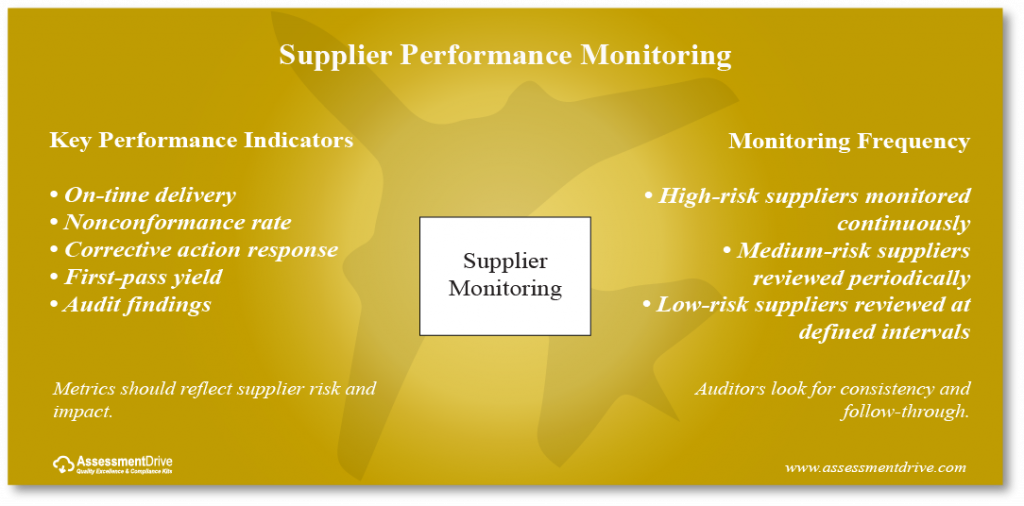
Key Performance Indicators
Supplier monitoring must use measurable data.
Common metrics include
• On-time delivery
• Nonconformance rate
• Corrective action responsiveness
• First-pass yield
• Audit findings
Metrics should reflect supplier risk and impact.
Monitoring Frequency
• High-risk suppliers monitored continuously
• Medium-risk suppliers reviewed periodically
• Low-risk suppliers reviewed at defined intervals
Auditors look for consistency and follow-through.
Supplier Re-Evaluation and Status Changes
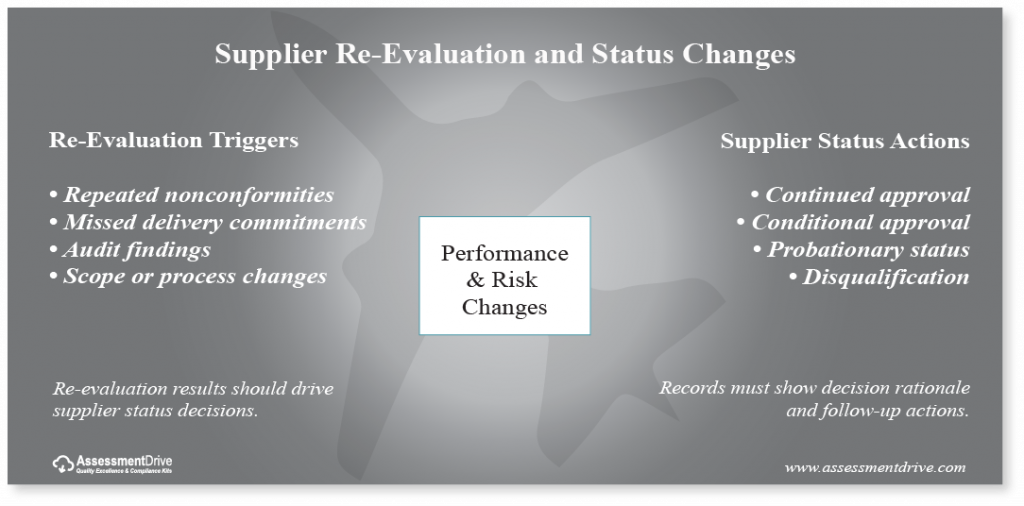
Re-Evaluation Triggers
Re-evaluation occurs when performance or risk changes.
Typical triggers include
• Repeated nonconformities
• Missed delivery commitments
• Audit findings
• Scope or process changes
Re-evaluation results should drive supplier status decisions.
Supplier Status Actions
• Continued approval
• Conditional approval
• Probationary status
• Disqualification
Records must show decision rationale and follow-up actions.
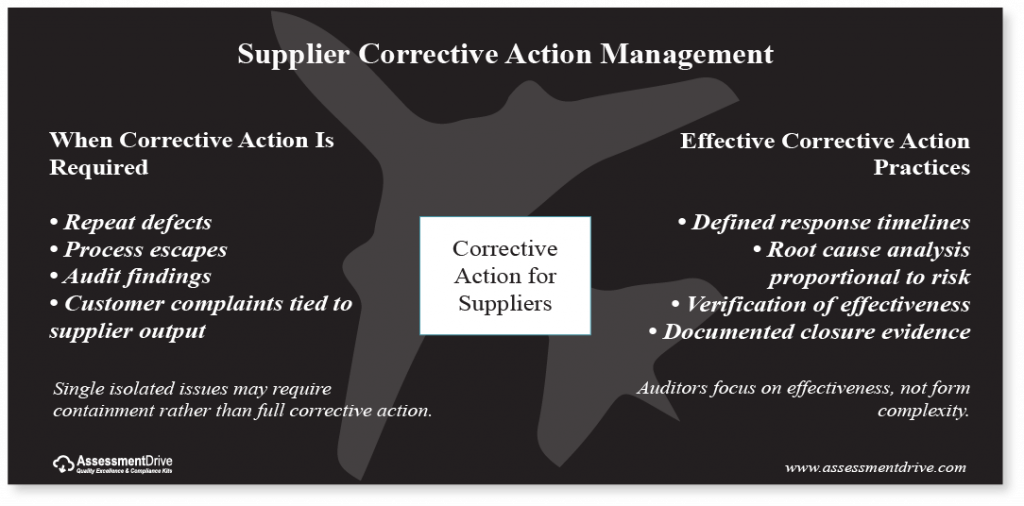
Supplier Corrective Action Management
When Corrective Action Is Required
Corrective action applies when issues indicate systemic breakdowns.
Examples include
• Repeat defects
• Process escapes
• Audit findings
• Customer complaints tied to supplier output
Single isolated issues may require containment rather than full corrective action.
Effective Corrective Action Practices
• Defined response timelines
• Root cause analysis proportional to risk
• Verification of effectiveness
• Documented closure evidence
Auditors focus on effectiveness, not form complexity.
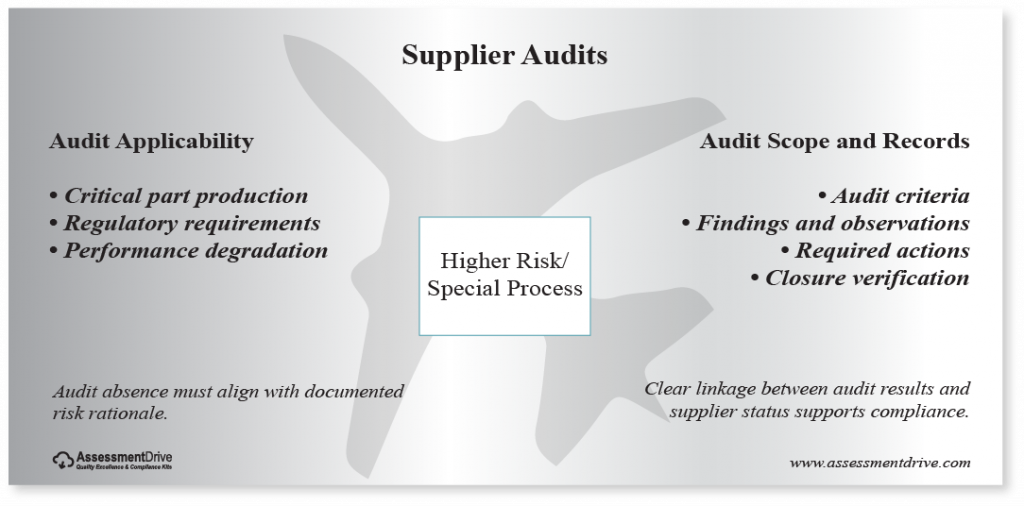
Supplier Audits
Audit Applicability
Supplier audits apply primarily to higher risk or special process providers.
Audit drivers include
• Critical part production
• Regulatory requirements
• Performance degradation
Audit absence must align with documented risk rationale.
Audit Scope and Records
Supplier audit records should include
• Audit criteria
• Findings and observations
• Required actions
• Closure verification
Clear linkage between audit results and supplier status supports compliance.
A practical way to move from principle to execution is to formalize how supplier risk is identified and translated into control levels. Once risk drivers such as part criticality, process type, performance history, and external certifications are defined, they can be used to segment suppliers into tiers. Each tier then drives a clear, pre-defined set of controls, ranging from basic approval and periodic review for low-risk suppliers to enhanced monitoring, inspection, and audit activities for high-risk suppliers. This bridge between risk assessment and control application is what turns risk-based thinking from a statement of intent into an operational system.
Common AS9100D Supplier Quality Findings
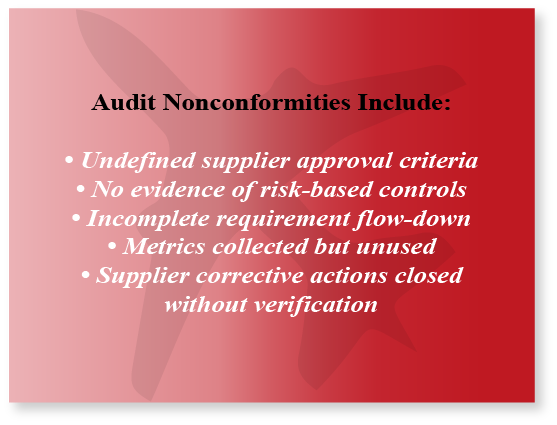
Frequent audit nonconformities include
• Undefined supplier approval criteria
• No evidence of risk-based controls
• Incomplete requirement flow-down
• Metrics collected but unused
• Supplier corrective actions closed without verification
Each issue traces back to weak process discipline rather than missing forms.
Building an Audit-Ready Supplier Quality System
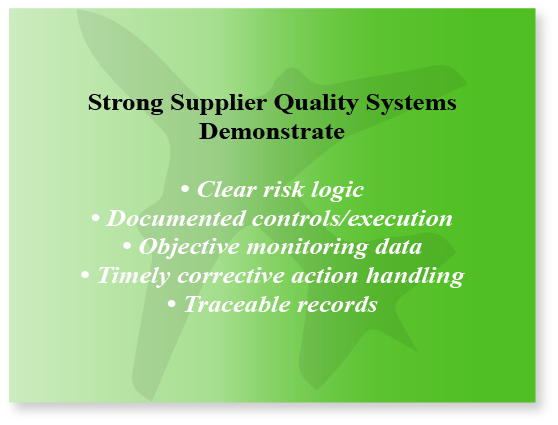
Strong supplier quality systems demonstrate
• Clear risk logic
• Documented controls aligned with execution
• Objective monitoring data
• Timely corrective action handling
• Traceable records
Auditors assess system effectiveness, not paperwork volume.
Final Perspective
Supplier quality management under AS9100D depends on structure, proportional control, and evidence. Organizations maintaining disciplined supplier processes reduce audit exposure, prevent escapes, and protect downstream operations.
Well-controlled suppliers reflect a mature quality management system and signal readiness for certification audits, surveillance audits, and customer scrutiny.
AS9100D Supplier Control Framework Flipbook (Visual Reference)
This flipbook provides a visual overview of a risk-based supplier control framework aligned with AS9100D Clause 8.4. It is intended as a quick reference within the article, reinforcing how supplier quality influences audit outcomes.
The content walks through supplier classification, risk segmentation, approval, requirement flow-down, performance monitoring, re-evaluation, and corrective action, showing how controls scale with supplier risk rather than remaining uniform.
Use the three-dot menu to download the flipbook locally for offline review or record retention. The directional arrow icon expands the flipbook for full-screen viewing. Selecting and dragging the lower-right corner allows preview as a live, page-turning booklet within the browser.
Ronnie Lee Roberts II has worked in the Department of Defense (DoD) quality environment since 2017, supporting programs at Patuxent River and Webster Field (NAWCAD/NAVAIR). A certified AS9100:2016 Rev D Lead Auditor (2022–2025), he brings deep knowledge of quality management systems, documentation control, and audit readiness across aerospace and defense operations. His background includes hands-on experience inspecting to specification per engineering drawings and customer requirements, verifying process conformity, and maintaining compliance with AS9100D clauses related to documented information, product realization, and risk management.
In addition to audit work, Ronnie has supported QMS development, technical writing, CAD-based documentation, and controlled record structures that ensure traceability and repeatability. He also holds ISO/IEC 20000-1:2018 Lead Auditor (TPECS, 2023) and Certified CMMI® Associate (2025) credentials, supporting CMMI-DEV Level 3 environments. His focus remains on aligning documentation and inspection practices with AS9100D standards to drive measurable quality performance and readiness for customer and regulatory audits.